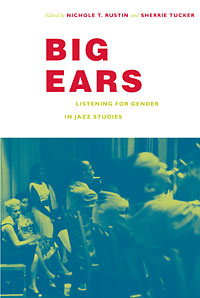
Nichole T. Rustin and Sherrie Tucker, ed., Durham, NC: Duke University Press, 2008
Contributors: Lara Pellegrinelli, Jeffrey Taylor, Monica Hairston, Christina Baade, Tracy McMullen, Jayna Brown, Julie Dawn Smith, Eric Porter, Sherrie Tucker, Ingrid Monson, Ursel Schlicht, João H. Costa Vargas, Farah Jasmine Griffin, Nichole T. Rustin, Kristin McGee
Excerpt from Introduction
“Big Ears: Listening for Gender in Jazz Studies is an interdisciplinary examination of gender in the histories, sounds, performances, representations, critiques, and lived experiences of those who, like ourselves, are invested in jazz culture and musical improvisation. Spanning a century of jazz culture and history, this anthology privileges gender analysis as a tool for exploring how the aesthetics of the music have been shaped, directed, and recorded by fans, critics, historians, and musicians, and for examining the conditions of possibility that artists have maintained and developed as jazz has grown. We imagine jazz culture in the broadest sense possible and the essays collected here share that vision. That broad scope is grounded by our contributors’ responses to the specific question of what we hear when we listen for gender in jazz. The approaches our contributors take to listening for gender reveal a critical commitment to representing the great variety of ways that their subjects dealt with the relationship between gender and jazz in aesthetic and lived experiences. Questioning gender draws attention, as our contributors illustrate, to the body, to race, to social and musical status, to narratives of origin (including that of exceptions, firsts, tradition), to subjects whose relationships to jazz cross traditional lines of gender, to difference, to sexuality. Although this is not intended to be a women-and-jazz anthology, our focus on gender analysis yields a proliferation of works concerned with women as jazz subjects. It is important to note that we allow this imbalance not as an attempt to ‘add women’ into existing scholarship, but because of the ways these studies demonstrate how gender helps us to ‘listen differently’ to areas of jazz culture that are otherwise too easily dismissed as ‘outside.'” (Rustin and Tucker, 2.)
 Sherrie Tucker