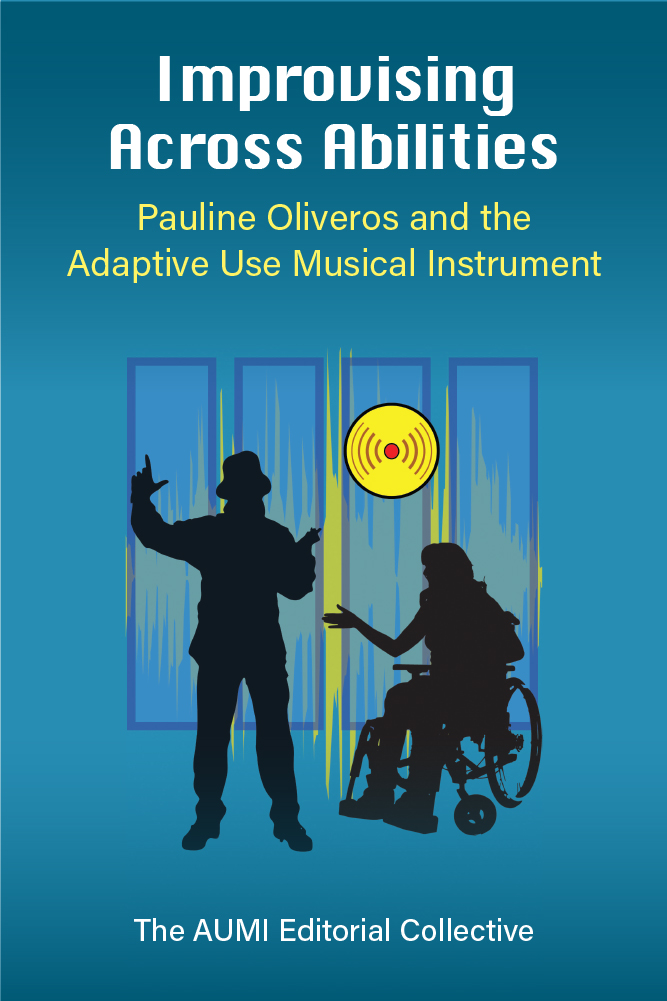
 The AUMI Editorial Collective, Ann Arbor: MI: University of Michigan Press (Music and Social Justice Series), 2024
“AUMI isn’t the app, it’s what people do with it!” So said composer, musician, humanitarian, and electronic music innovator Pauline Oliveros (1932-2016). The Adaptive Use Musical Instrument (AUMI) is a downloadable musical instrument designed to be played by everybody and every body. It is an aspirational project to facilitate what Pauline liked to call “improvising across abilities.”
AUMI has been available free of charge since its release in 2007, and downloaded by hundreds of people internationally. But the question remained: what do people do with it? Thanks to the generous input of AUMI users to this unusual collaborative book project, we now know much more than we did! Readers may learn from performers, disability advocates and activists, teachers, music therapists, disability and mixed-ability communities, developers, and philosophers and come up with ideas of their own. The book is both information and invitation.</P
The book features 50+ authors and artists who have creatively engaged this all-ability adaptive musical instrument! Includes: Thomas Ciufo, Abbey L. Dvorak, Kip Haaheim, Jennifer Hurst, IONE, Grace Shih-en Leu, Leaf Miller, Ray Mizumura-Pence, Nicola Oddy, Jesse Stewart, John Sullivan, Sherrie Tucker, Ellen Waterman, Ranita Wilks, Tami Albin, Jim Barnes, Karen Berglander, Jonas Braach, Julie Brocklehurst, Rebecca Caines, Teresa Connors, Ty Dykema, Laurel Forshaw, Gale Franklin, Ivan Franco, Oliver Hall, Ian Hattwick, Michelle Heffner Hayes, Sergio Hazzard, Nicole Hodges Persley, Jessie Huggett, David Knott, Carrie Lennard, Eric Lewis, George Lipsitz, Jack Hui Litster, Henry Lowengard, Alex Lubet, James Maxson, James Mulcahey, Deborah A. Nelson, Nancy Patterson, Matt Robidoux, Gillian Siddall, Clara Tomaz, Julie Unruh, Zane Van Dusen, Lise Vaugeois.
Open Access! Online Resources!
It is fitting that a accessible musical instrument should have an accessible book! It is available for purchase, but you can also read it and download the PDF online. Includes 53 media resources! Open Access Link for AUMI Book and Resources
Read the book and play along! Download AUMI
Reviews
Improvising Across Abilities is perhaps the only manuscript of its kind: one that explores the applications of one adaptive music technology, AUMI, in extraordinary depth through multivalent perspectives and scenarios via the words and metaphors of an extraordinarily varied collective of writers, students, teachers, social justice workers, technologists, community activists, group home directors, and creatives. While most scholarly essay collections feature chapters by academics from a narrow range of fields (if not a single one), this volume’s editorial team has consciously drawn writing from members of the public community who might not ordinarily contribute to such a collection, as well as from artists, scientists, and professors who write as part of their profession. The variation in writers and voices not only adds to the value of the book, but reinforces its argument that everyone, no matter what shape, size, or ability, should have a voice.
–
STEPHANIE JENSEN-MOULTON, co-editor of the Oxford Handbook of Music and Disability Studies (2016)
The awe-inspiring creator and thinker Pauline Oliveros is recognized for her pioneering electronic compositions, the astonishing diversity of her musical creations, her multifaceted poetic and expository writing, and her dedicated teaching of Deep Listening over many years. Some of her best-known work, the Sonic Meditations and Deep Listening Pieces, offers brief verbal instructions to allow groups to create musical experiences together, regardless of the musical training or experience of the people involved. An extension of this inclusiveness came in her later years with the Adaptive Use Musical Instrument (AUMI), now a freely downloadable app that allows users, including people with limited physical mobility, to participate in music making in new and provocative ways. This well-conceived book makes available a stunning wealth of information about AUMI by writers from many different backgrounds.
–
– FRED MAUS, Co-editor, The Oxford Handbook of Music and Queerness (2022)
 Sherrie Tucker